The fastest way into ASL is a small set of high-frequency signs: greetings, manners, and everyday words you will actually use. Master these 15 first and you can handle simple interactions while you keep learning. Each sign below links to a step-by-step guide with practice tips.
Greetings
Hello
Raise your dominant hand to your forehead, palm out, then move it away in a small salute-like motion — a crisp, friendly salute. Step-by-step guide to Hello
Goodbye
Raise your open hand, palm facing out, and wave it side to side — the everyday wave works in ASL too. Step-by-step guide to Goodbye
Manners
Thank you
Touch your chin with the fingertips of your flat hand, then move your hand forward and slightly down, ending palm-up — as if sending gratitude forward. Step-by-step guide to Thank you
Please
Place your flat dominant hand palm-down on your chest and rub it in a small clockwise circle — a flat hand circling the heart. Step-by-step guide to Please
Sorry
Make a loose fist and rub it in small circles over your heart. Note the classic beginner mix-up: PLEASE is a flat hand, SORRY is a fist. Step-by-step guide to Sorry
Yes, no, and help
Yes
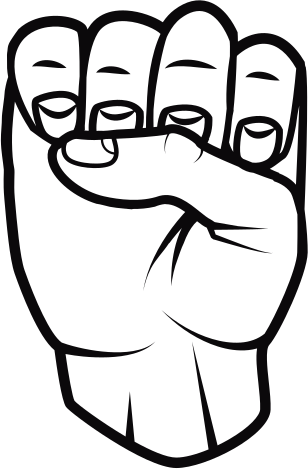
Make a fist with your thumb across your fingers and nod it up and down, like a head nodding yes — and pair it with a real head nod. Step-by-step guide to Yes
No
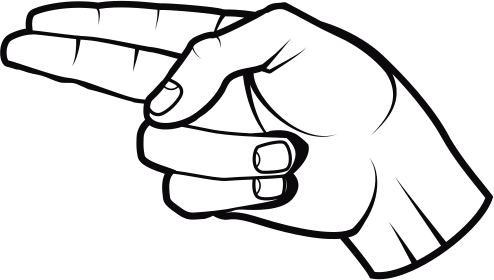
Extend your index and middle fingers and tap the two fingertips against your thumb once or twice — it blends the fingerspelled N and O. Always pair it with a side-to-side head shake. Step-by-step guide to No
Help
Rest a dominant fist on your other open palm and lift both hands upward together. To offer help to someone, lift the hands toward them. Step-by-step guide to Help
People and feelings
Love
Cross both arms over your chest and rest each fist on the opposite shoulder — a hug for yourself. Step-by-step guide to Love
Friend
Hook your two index fingers together, then reverse them so the other finger ends up on top — interlocked fingers, a friendship link. Step-by-step guide to Friend
Happy
Hold your flat hand at your chest, palm facing in, and brush it upward firmly once or twice — happy feelings rise upward. Step-by-step guide to Happy
Sad
Hold both open hands in front of your face, palms in, and drag them downward — the movement mirrors a long face. Step-by-step guide to Sad
Everyday words
Eat
Bring your bunched fingertips to your mouth once or twice, as if putting food in your mouth. It also means FOOD — context tells which. Step-by-step guide to Eat
Drink
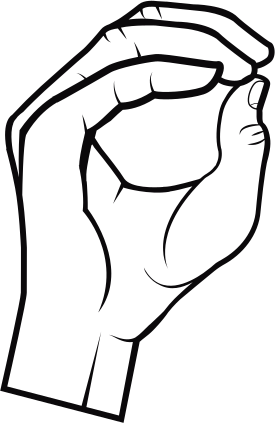
Form a C with your hand as if holding a cup, bring it to your mouth, and tilt it back slightly — a mime of taking a sip. Step-by-step guide to Drink
Water
Form a W with index, middle, and ring fingers up, and tap the index-finger side of your hand against your chin twice. Step-by-step guide to Water
Frequently asked questions
- How many signs should a beginner learn first?
- Start with 15–20 high-frequency signs like the ones in this article — greetings, manners, and everyday words. That is enough to have simple interactions. From there, expand into topics that matter in your daily life: family, food, work, hobbies.
- Should I learn signs or fingerspelling first?
- Signs first. Everyday ASL conversation is mostly word-level signs; fingerspelling is for names, places, and words with no established sign. The 15 signs below will get you further, faster, than spelling words letter by letter.
- How long does it take to learn these 15 signs?
- Most beginners can perform all 15 within a few focused practice sessions. The harder part is recalling them smoothly in conversation, which takes a week or two of daily practice — short sessions beat occasional long ones.
- Do I need to learn the ASL alphabet too?
- Yes, but treat it as a second skill alongside word signs. Our fingerspelling guide covers the one-handed ASL alphabet — learn it for names and new words, and use the signs below for everything else.
- How do I remember which sign is which?
- Use the visual logic of each sign: please circles the heart, love is a self-hug, drink mimes a cup. The step-by-step guides linked below explain that logic, and learning the image behind the sign makes it stick.
- How do I sign hello, please, and thank you?
- Hello: raise your dominant hand to your forehead, palm out, and move it away in a small salute. Please: place your flat dominant hand palm-down on your chest and rub it in a small clockwise circle. Thank you: touch your chin with flat-hand fingertips, then move the hand forward and slightly down, ending palm-up.
- Is ASL hard for beginners?
- No more than any new language. The first signs come quickly because many are visual and intuitive. The real challenge is the same as any language: grammar, speed, and recall in live conversation — all of which come from regular practice with other signers.
- What is the easiest way to learn ASL?
- Combine three things: a core set of high-frequency signs like the 15 above, daily short practice sessions (15–20 minutes beats a weekly marathon), and — most importantly — learning from Deaf instructors and the Deaf community. Free resources exist, but a human signer checking your signs is what makes them stick.
- Is learning from text descriptions enough?
- It is a good start, but sign language is visual. Practise in front of a mirror, watch Deaf signers, and — most importantly — learn with Deaf instructors and the Deaf community to check your signs and build real fluency.
Keep learning
- ASL & BSL signs dictionaries — keep building your vocabulary, word by word.
- How to fingerspell your name in ASL — for names, places, and words with no established sign.
- ASL vs BSL: 7 key differences — why these signs are specific to American Sign Language.