Fingerspelling your name is the first thing most ASL learners learn — and the first thing they get wrong. The ASL manual alphabet is one-handed: 26 handshapes made with your dominant hand, 24 of them static and 2 made with movement. This guide walks you through spelling any name clearly, letter by letter.
Step 1: Learn each letter's handshape
Before spelling your name, learn the individual letters. Our ASL alphabet reference shows every A–Z handshape. Go through the alphabet slowly and form each letter until the handshapes feel familiar — don't try to spell words until the letters themselves are comfortable.
Step 2: Position your hand correctly
Hold your dominant hand up near your shoulder or cheek, palm facing outward toward the person reading. Keep your wrist fairly steady — the movement happens in your fingers, not your arm. Dropping your hand to waist level is the most common beginner mistake; it forces the reader to look down and breaks eye contact, which matters in signed conversation.
Step 3: Spell with a steady rhythm
Form each letter of your name in order, flowing smoothly from one handshape to the next without full pauses between letters. Keep a steady rhythm — imagine a metronome, not a strobe light. Hold the final letter of your name slightly longer; that tiny hold tells the reader where the word ends.
Step 4: Handle the motion letters — J and Z
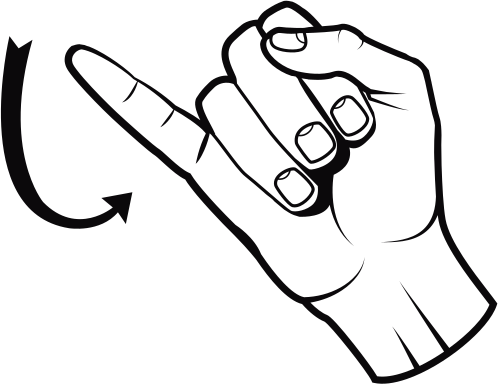
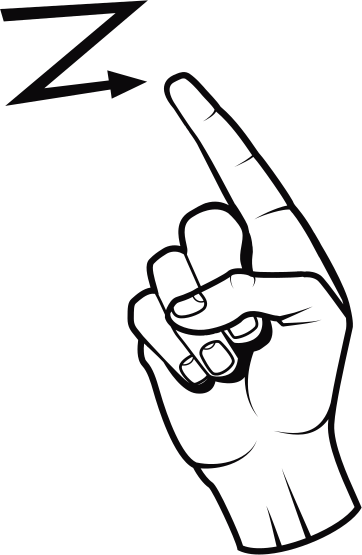
Two ASL letters need movement:
- J: make the I handshape (pinky up) and trace the shape of a J in the air with your pinky.
- Z: point your index finger and trace the shape of a Z in the air.
If your name contains J or Z, practise the tracing motion separately until it's smooth, then fold it into the rhythm of the full name.
Step 5: Practise the right way
- Spell your name in front of a mirror and watch for clarity, not speed.
- Practise receptive fingerspelling too — try reading words in our translator, which fingerspells any word letter by letter.
- Learn the manual alphabet in chunks (A–G, H–N, O–U, V–Z) rather than all 26 at once.
- Spell real words, not random letter strings — your brain learns patterns faster.
Frequently asked questions
- Which hand do I fingerspell with in ASL?
- Use your dominant hand — the hand you write with. Keep it up near your shoulder, palm facing outward (toward the person reading your signing), and keep it fairly still while your fingers form each letter.
- Which ASL letters use movement? How do you sign J and Z?
- Only J and Z. For J, make the I handshape (pinky up) and trace the shape of a J in the air with your pinky. For Z, point your index finger and trace the shape of a Z in the air. All 24 other ASL letters are static handshapes — signing J or Z without the movement is one of the most common beginner mistakes.
- Should I fingerspell fast to look fluent?
- No — readability beats speed. Beginners who rush produce blurry, unreadable letters. Aim for clear, evenly spaced letters first; speed comes naturally with practice. Deaf signers read fingerspelling by overall word shape, which only works when each letter is distinct.
- Do I need to pause between letters?
- Don't pause fully between letters — that breaks the word into pieces. Instead, flow smoothly from one handshape to the next with a steady rhythm, holding the final letter of a word slightly longer to mark the word boundary.
- When should I fingerspell instead of using a sign?
- Fingerspell proper names (people, places, brands), technical terms with no established sign, and words you don't know the sign for yet. Most everyday conversation uses word-level signs — fingerspelling everything is slow and tiring to read.
- Can I give myself a name sign?
- No — name signs are given to you by Deaf people who know you, never invented by yourself. Until you receive one, fingerspell your name. Inventing your own name sign is considered disrespectful in Deaf culture.
- Is the ASL alphabet the same as the BSL alphabet?
- No. ASL uses a one-handed alphabet; BSL uses a two-handed alphabet where the non-dominant hand acts as a base. The handshapes are completely different — our alphabet page covers both systems side by side.
Keep learning
- ASL & BSL alphabet reference — every handshape, including the motion letters and the two-handed BSL alphabet.
- ASL & BSL signs dictionaries — move beyond letters to real word-level signs.