The single most important thing to know about American Sign Language and British Sign Language is that they are separate languages, not dialects of one "sign language." A fluent ASL signer and a fluent BSL signer cannot understand each other without study. Here are the seven differences that matter most for a beginner.
1. One-handed vs two-handed alphabets
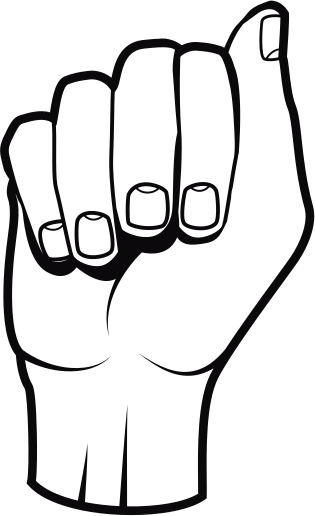
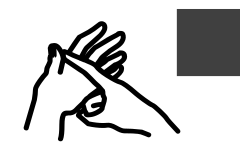
The most visible difference. ASL fingerspells with one hand — 26 handshapes made with the dominant hand. BSL fingerspells with two hands, using the non-dominant hand as a steady base that the dominant hand touches to form each letter. The handshapes are entirely different systems, so fingerspelling knowledge does not transfer between them. See our guides to fingerspelling in ASL and fingerspelling in BSL for the full breakdown of each.
2. Separate vocabularies
Everyday words use completely different signs. Compare hello in ASL with hello in BSL — the signs look nothing alike, and the same is true for thank-you, please, sorry, and most of the core vocabulary. Assume no sign is shared until you have checked both dictionaries.
Same word, two languages: side-by-side demos
Nothing makes the difference clearer than seeing one word signed in both languages. Pick a word and compare the step-by-step guides:
- Mother — ASL mother vs BSL mother
- Thank you — ASL thank-you vs BSL thank-you
- Name — names have no word sign in either language; they are fingerspelled. Compare fingerspelling your name in ASL with fingerspelling your name in BSL
3. Separate grammars
Each language has its own grammar, and neither one maps onto English word order. Both use space, facial expression, and sentence structure in ways that English speakers have to learn from scratch — so do not expect that learning the vocabulary is enough, or that grammar knowledge transfers between the two.
4. Different number systems
The manual number systems differ too. On this site, the dictionary covers ASL numbers 0–10 alongside the core BSL numbers 1–5; beyond the basics, BSL numbers vary regionally across the UK, so learners should check what their local Deaf community uses. Either way, counting is one more thing you have to learn separately for each language.
5. Mouthing plays a bigger role in BSL
In BSL, mouthing English words silently while signing is a normal, expected part of the language — it often carries real meaning, and can even distinguish signs that are identical on the hands (in BSL, "please" and "thank you" share the same manual sign; the mouth pattern tells them apart). ASL uses mouth movements too, but English-like mouthing is far less central.
6. Fingerspelling is used more in BSL
Because BSL lacks an established sign for many words, fingerspelling carries more of the conversational load in BSL than in ASL — names, places, and technical terms get spelled out constantly. This is one reason strong two-handed fingerspelling is considered an essential BSL skill rather than a backup tool.
7. Different language families
The two languages come from entirely different roots. ASL descends from the French Sign Language family, brought to America in the 19th century. BSL belongs to the BANZSL family — the sign-language family shared by Britain, Australia, and New Zealand. That is why two countries that speak the same spoken language ended up with completely different sign languages.
Frequently asked questions
- Is BSL a dialect of ASL?
- No. They are separate languages with separate histories. They do not share an alphabet, their vocabularies overlap very little, and they developed independently on different continents.
- Are ASL and BSL mutually intelligible?
- No. A fluent signer of one cannot automatically follow the other — much like a French speaker and a Spanish speaker share a few clues but not a conversation. Shared roots help slightly, but that is all.
- Is ASL one-handed and BSL two-handed?
- For fingerspelling, yes — ASL uses a one-handed alphabet, BSL a two-handed one built around a base hand. But the languages differ far beyond fingerspelling: separate vocabularies, grammars, and number systems too.
- Do ASL and BSL share an alphabet?
- No. They use completely separate manual alphabets — one-handed in ASL, two-handed in BSL — with different handshapes for every letter. Knowing one alphabet gives you no head start on the other.
- Which should I learn first, ASL or BSL?
- Learn the one used by the Deaf community around you. If you live in the United States or Canada, ASL; in the United Kingdom, BSL. Signing the 'wrong' one for your region means nobody local can understand you, so local use beats everything else.
- Is sign language universal?
- No. There are hundreds of distinct sign languages worldwide. ASL is used mainly in the US and much of Canada, BSL in the UK, and dozens of others — Auslan, LSF, DGS, and more — each with its own grammar and vocabulary.
- Do ASL and BSL share any signs at all?
- Some everyday gestures, like a friendly wave for hello, may look similar simply because they mirror natural human gestures. But you should never assume a sign is shared — check the sign in the dictionary for the language you are learning.
- Is one of them easier to learn?
- Neither is objectively easier. ASL's one-handed alphabet is quicker to pick up for fingerspelling, while BSL's two-handed alphabet takes more coordination at first. Real difficulty comes from grammar and fluency, and both languages demand the same effort there.
Keep learning
- ASL & BSL alphabet reference — both alphabets, side by side.
- How to fingerspell your name in ASL — the one-handed system in detail.
- How to fingerspell your name in BSL — the two-handed system in detail.
- ASL & BSL signs dictionaries — start building vocabulary in whichever language you choose.