Most beginners judge their fingerspelling by speed. Fluent signers judge it by one thing: can I read it? Blurry, rushed letters are the norm in beginner signing, and they defeat the whole purpose. These seven rules are about technique, not talent — follow them and your fingerspelling becomes clear long before it becomes fast.
Rule 1: Readability over speed
The golden rule. Fingerspelling faster than your accuracy allows produces blurred handshapes that no one can parse. Deaf signers read fingerspelling by overall word shape, and that only works when each letter is distinct. Make every letter clear first; speed is a side effect of accuracy plus time, and it will arrive on its own.
Rule 2: Keep a steady rhythm — no full pauses between letters
Flow smoothly from one handshape to the next without stopping fully between letters. Pauses chop the word into pieces and destroy the word shape the reader relies on. Think metronome, not strobe light: even, continuous motion where each letter gets its moment and the transitions stay fluid.
Rule 3: Park your hand in the right spot
Hold your signing hand up around shoulder or cheek height, in a comfortable spot the reader can see without looking away from your face. Palm orientation follows your language: in ASL the palm faces outward toward the reader; BSL fingerspelling uses both hands, with the non-dominant hand acting as a base for the dominant hand's letters. The most common beginner mistake across both languages is letting the hand drift down to waist level — it forces the reader to look down and breaks the eye contact that signed conversation depends on.
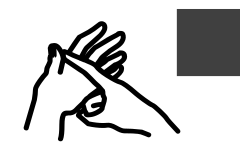
BSL A
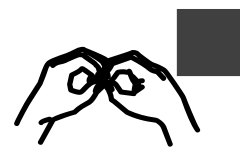
BSL B
Rule 4: Hold the final letter slightly longer
When you reach the last letter of a word, hold it a beat longer than the rest. That tiny hold is the visual equivalent of a space between words in text — it tells the reader where one word ends and the next begins. Without it, multi-word fingerspelling runs together into one long blur.
Rule 5: Fingerspell only when you should
Fingerspelling is a tool, not a default mode. Use it for proper names (people, places, brands), technical terms with no established sign, and words whose sign you haven't learned yet. Most everyday conversation runs on word-level signs, which are faster and far easier to read. Fingerspelling everything is slow and tiring for the reader — and it signals that you haven't started learning real signs yet.
Rule 6: Practise reading, not just producing
Receptive fingerspelling — reading what others spell — is a separate skill, and beginners usually neglect it. You can't learn it from handshape charts alone; it comes from watching real signing and training your eye to catch word shapes at natural speed. Watch Deaf signers fingerspell, slow it down if you can, and resist the urge to decode letter by letter — word-shape reading is the goal.
Rule 7: Use a mirror and learn in chunks
A mirror is the cheapest fingerspelling coach there is: it shows you exactly what your reader sees, including dropped hands and mushy letters. And don't try to learn all 26 letters at once — learn the alphabet in chunks (A–G, H–N, O–U, V–Z), then spell real words, not random letter strings, because your brain learns letter patterns faster in real words.
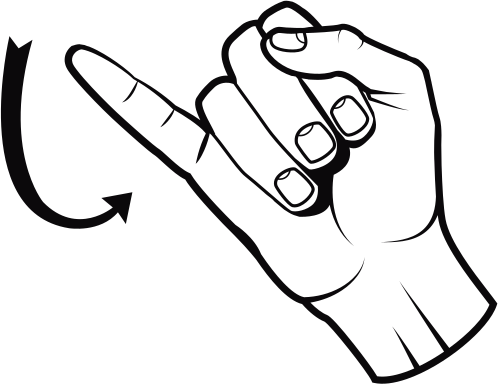
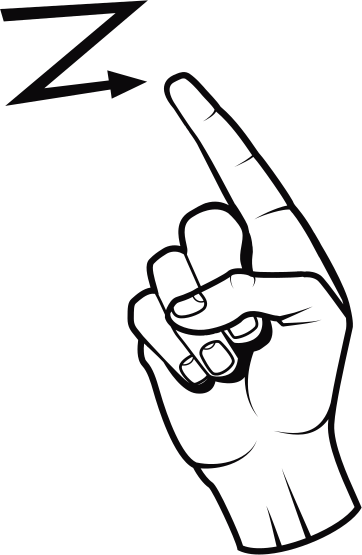
Double letters: bounce, don't stretch
Words like Anna, book, and letter trip up beginners because the instinct is to hold one long letter for the doubled pair — but that reads as a single letter. The standard technique is to re-articulate the letter: a slight bounce (a small, quick re-forming of the handshape) or a tiny slide of the hand as you remake the letter. The bounce happens on the rhythm's beat — no full pause between the two letters, or the word breaks apart.
- ANNA: form N, then bounce into a fresh N — two clear beats, same steady rhythm as the rest of the word.
- BOOK: form O, re-articulate O with a small bounce before moving on to K.
- LETTER: form T, bounce into T again, then finish with E and R without rushing.
- In BSL: the same idea — a small bounce of the dominant hand against the steady base hand marks the doubled letter.
Practise doubles in isolation first (NNN, OOO, TTT — bounce each one), then inside real words. If your doubles look like singles, you're stretching; if they look like two letters, you've got it.
Common mistakes to avoid
- Racing before you're accurate — speed without clarity is unreadable.
- Pausing fully between letters, which breaks words into pieces.
- Letting the hand drift to waist level, breaking eye contact.
- Holding a double letter as one long letter instead of re-articulating it.
- Only practising production and never practising reading others' fingerspelling.
- Fingerspelling words that have perfectly good word-level signs.
Frequently asked questions
- How can I practice fingerspelling alone?
- Use a mirror so you see what a reader sees, learn the alphabet in chunks (A–G, H–N, O–U, V–Z), and spell real words rather than random letter strings — your brain learns letter patterns faster in real words. Film yourself and watch it back: dropped hands and mushy letters are obvious on playback. Our alphabet page works as a self-check reference.
- How do I get better at reading fingerspelling?
- Reading (receptive) fingerspelling is a separate skill from producing it, and it only improves through exposure. Watch Deaf signers fingerspell — slow the video down if you can — and train your eye to catch whole word shapes rather than decoding letter by letter. Guessing the word from context and word shape is how fluent signers do it.
- Should you bounce your hand when fingerspelling?
- For double letters, yes — a slight bounce (re-articulating the handshape) is the standard way to mark a doubled letter like the NN in 'Anna'. Otherwise, no: keep the hand steady and in position, and let the movement happen in your fingers. Bouncing between every letter looks jittery and breaks the rhythm.
- What's the difference between expressive and receptive fingerspelling?
- Expressive fingerspelling is producing it — spelling words with your own hands. Receptive fingerspelling is reading it — understanding what someone else spells. Beginners almost always over-practise expressive and neglect receptive, then can't follow real conversations. Practise both: spell words yourself, and watch others spell.
- How do I fingerspell double letters like the NN in 'Anna'?
- Don't hold one long N — that reads as a single letter. Re-articulate: form N, then bounce into a fresh N on the rhythm's beat, with no full pause between the two. The same bounce-or-slide technique works for OO in 'book' and TT in 'letter'; in BSL, bounce the dominant hand against the steady base hand.
- How long does it take to get good at fingerspelling?
- Clear, comfortable fingerspelling of everyday words typically takes weeks to a few months of short daily practice — not years. The bottleneck is rarely the handshapes; it's learning a steady rhythm and reading other people's fingerspelling, which improves with exposure, not drills alone.
- When should I fingerspell instead of using a sign?
- Fingerspell proper names (people, places, brands), technical terms with no established sign, and words whose sign you haven't learned yet. In normal conversation most meaning is carried by word-level signs — fingerspelling everything is slow and hard to read, so treat it as a tool, not a default.
Keep learning
- ASL & BSL alphabet reference — every handshape, including the motion letters and the two-handed BSL alphabet.
- How to fingerspell your name in ASL — step-by-step practice with your own name.
- How to fingerspell your name in BSL — the two-handed system, step by step.