In American Sign Language, “I miss you” is signed as three parts: I → MISS → YOU. Point to yourself, make the MISS sign, then point to the person. Here’s each step.
Step 1: I — point to yourself
Touch your index finger to your chest, pointing at yourself. Simple, natural — just like pointing at yourself in any conversation.
Step 2: MISS — the chin poke
This is the key sign. Put a sad, wistful look on your face — the expression is part of the sign, not decoration — and poke your straight index finger into the cleft of your chin. (Researched from Dr. Bill Vicars’ ASL University Q&A materials at Lifeprint.com, rewritten in our own words.)
Step 3: YOU — point to them
Point your index finger directly toward the person you’re signing to. If they’re not present, point toward the space where you’ve “placed” them in the conversation.
No MISS sign handy? Fingerspell it
Fingerspelling M-I-S-S is always acceptable and always understood. Keep each letter clear and evenly spaced:

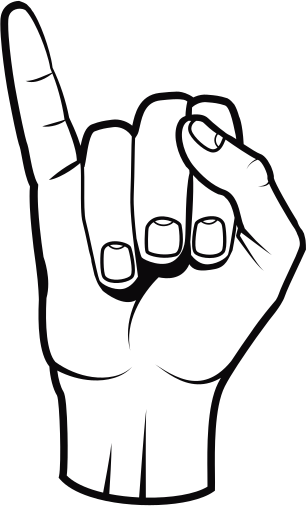

Our translator fingerspells any word like this, letter by letter.
What about BSL?
An honest note: our BSL dictionary doesn’t have a researched MISS sign yet, and BSL signs are never interchangeable with ASL. For now, fingerspell M-I-S-S with the two-handed BSL alphabet, or look it up in BSL SignBank for your region’s sign.
Variations
- “I miss you so much”: sign I-MISS-YOU with a stronger, more emotional facial expression and slightly larger movement — intensity in sign language lives in the face and the size of the movement.
- “I missed you” (past): same signs; context carries the tense. You can add a sign like FINISH or YESTERDAY before it if the timing matters.
Frequently asked questions
- How do you sign ‘I miss you’ in ASL?
- Sign it as three parts: point your index finger to yourself (I), then the MISS sign — a sad, wistful expression while you poke your straight index finger into the cleft of your chin — then point your index finger toward the person (YOU).
- What is the sign for ‘miss’ in ASL?
- For ‘miss’ as in missing someone: put a sad, wistful look on your face and poke your straight index finger into the cleft of your chin. This is the form taught in Dr. Bill Vicars’ ASL University (Lifeprint) Q&A materials.
- How do you sign ‘I miss you’ in BSL?
- Honestly: our BSL dictionary doesn’t have a researched MISS sign yet, so don’t guess one. Fingerspell M-I-S-S clearly with the two-handed BSL alphabet, or check BSL SignBank for the regional sign. Never substitute the ASL sign and call it BSL.
- Is there a difference between signing ‘I miss you’ and ‘I missed you’?
- The MISS sign itself stays the same; tense comes from context — the rest of your sentence or the situation makes clear whether you mean now or in the past. ASL doesn’t change the verb form the way English adds ‘-ed’.
- Can I just fingerspell ‘I miss you’ instead of signing it?
- Yes — fingerspelling M-I-S-S (with I and YOU as points, or fully fingerspelled) is always acceptable and always understood. It’s slower than the sign, but it’s never wrong.
- What’s the difference between ‘I miss you’ and ‘I love you’ in ASL?
- They’re completely different signs. ‘I love you’ combines I, LOVE and YOU (and has its own famous one-handed sign), while ‘I miss you’ uses the chin-poke MISS sign. Don’t mix them up — see our step-by-step guide for ‘I love you’ in the dictionary.
Keep learning
- How to sign “I love you” in ASL — a related phrase with its own famous sign.
- How to sign “I love you” in BSL — the British version.
- How to sign “love” in ASL and how to sign “sad”.
- Learn sign language — our daily step-by-step article series.